What Is a Resilience Hub—and Why Should Your Community Consider One?

When extreme heat, flooding, severe storms, or extended power outages affect a community, residents need more than infrastructure that can withstand the event. They need places they know, trust, and can turn to for information, resources, basic services, and connection.
That is where a resilience hub can play an important role.
Resilience hubs are gaining attention as communities look for ways to prepare for disruptions while also investing in facilities and services that benefit residents every day. However, creating an effective resilience hub involves more than adding a generator to a public building or designating another emergency shelter.
Done well, a resilience hub brings together community needs, resilient infrastructure and energy, and operational continuity in one place.
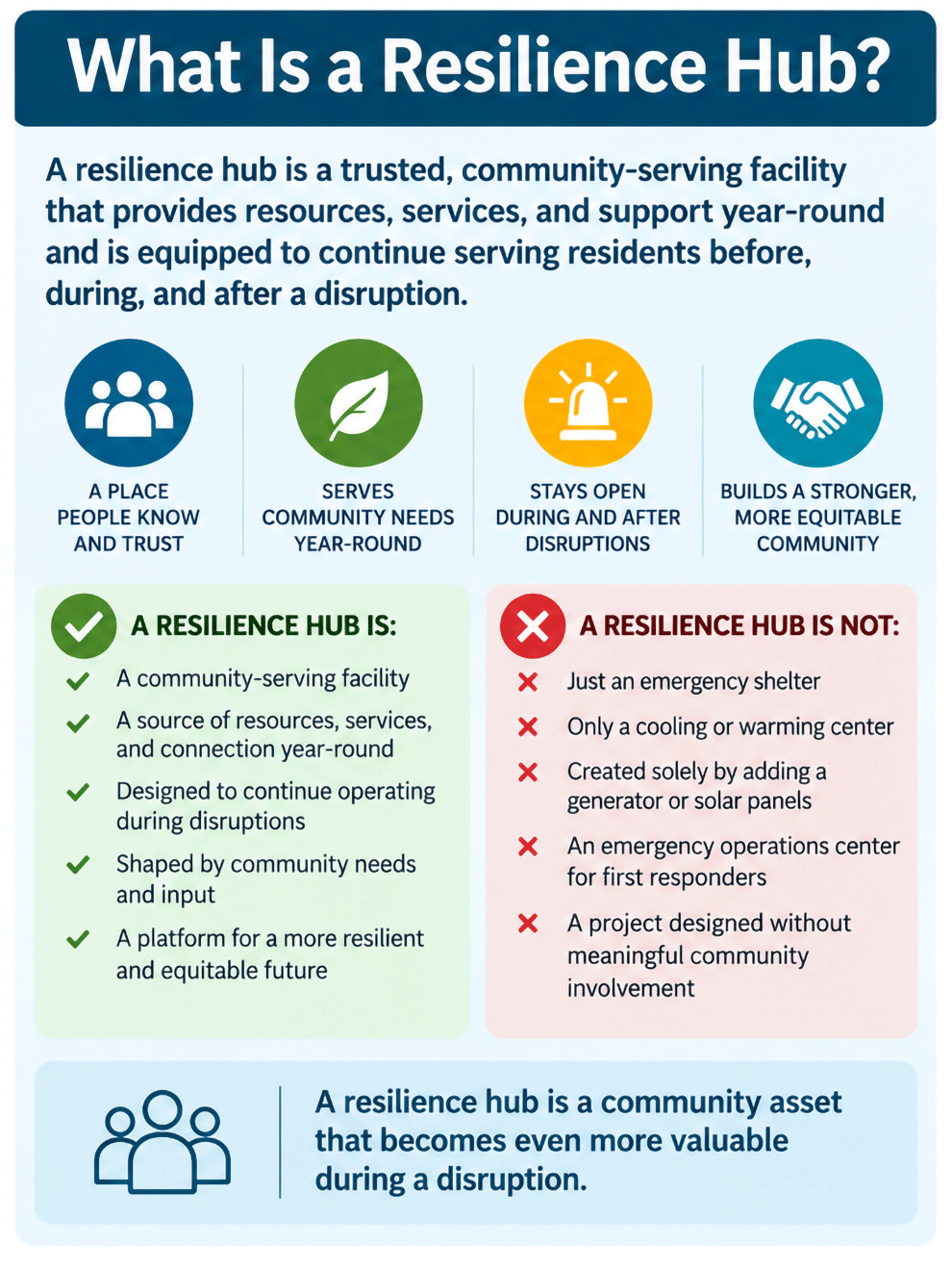
The Urban Sustainability Directors Network (USDN), which has developed extensive guidance around resilience hubs, describes them as community-serving facilities that are enhanced to support residents and coordinate resources and services before, during, and after natural hazard events. Importantly, USDN emphasizes the use of established, trusted facilities that serve their neighborhoods and communities year-round.
That year-round role is what sets the resilience hub concept apart from an emergency shelter or cooling or warming center.
A resilience hub might provide community programming, internet access, health or social services, meeting space, workforce development, food distribution, or other locally identified services during normal conditions or “blue sky” days. During an emergency or “grey sky” days, that same facility might provide heating or cooling, electrical power, charging, communications, access to information, refrigeration for medicines, distribution of supplies, or other critical functions.
The exact combination should reflect the people, their needs and potential vulnerabilities, and the natural and possible manmade hazards of the community it serves.
Resilience hubs can also incorporate physical improvements such as renewable energy, battery storage, microgrids, efficient building systems, resilient mechanical and electrical systems, flood protection, green infrastructure, or other measures designed to help the facility continue operating during a disruption.
What a resilience hub is not
A resilience hub is not simply another name for an emergency shelter or a community center.
It is also not automatically created by putting solar panels, batteries, or a backup generator on a municipal building. Those investments may be important components of a hub, but they do not create one by themselves.
A true resilience hub begins with the community.
USDN’s resilience hub framework emphasizes daily community needs, community capacity, and a strong role for residents and community-based organizations in shaping and managing hubs. Across the Northeast, resilience initiatives such as the MA Municipal Vulnerability Preparedness (MVP) Program and the CT DEEP Climate Resilience Fund, similarly emphasize locally led planning, community engagement, partnerships, and understanding the needs of populations that may be particularly vulnerable to hazards.
That leads to a useful way of thinking about the concept:
A resilience hub isn’t a building that suddenly becomes useful during an emergency or disruptive event. It is a community asset that becomes even more valuable during one.
Once a community determines that a resilience hub could meet an identified need, another major question follows:
Where should it go?
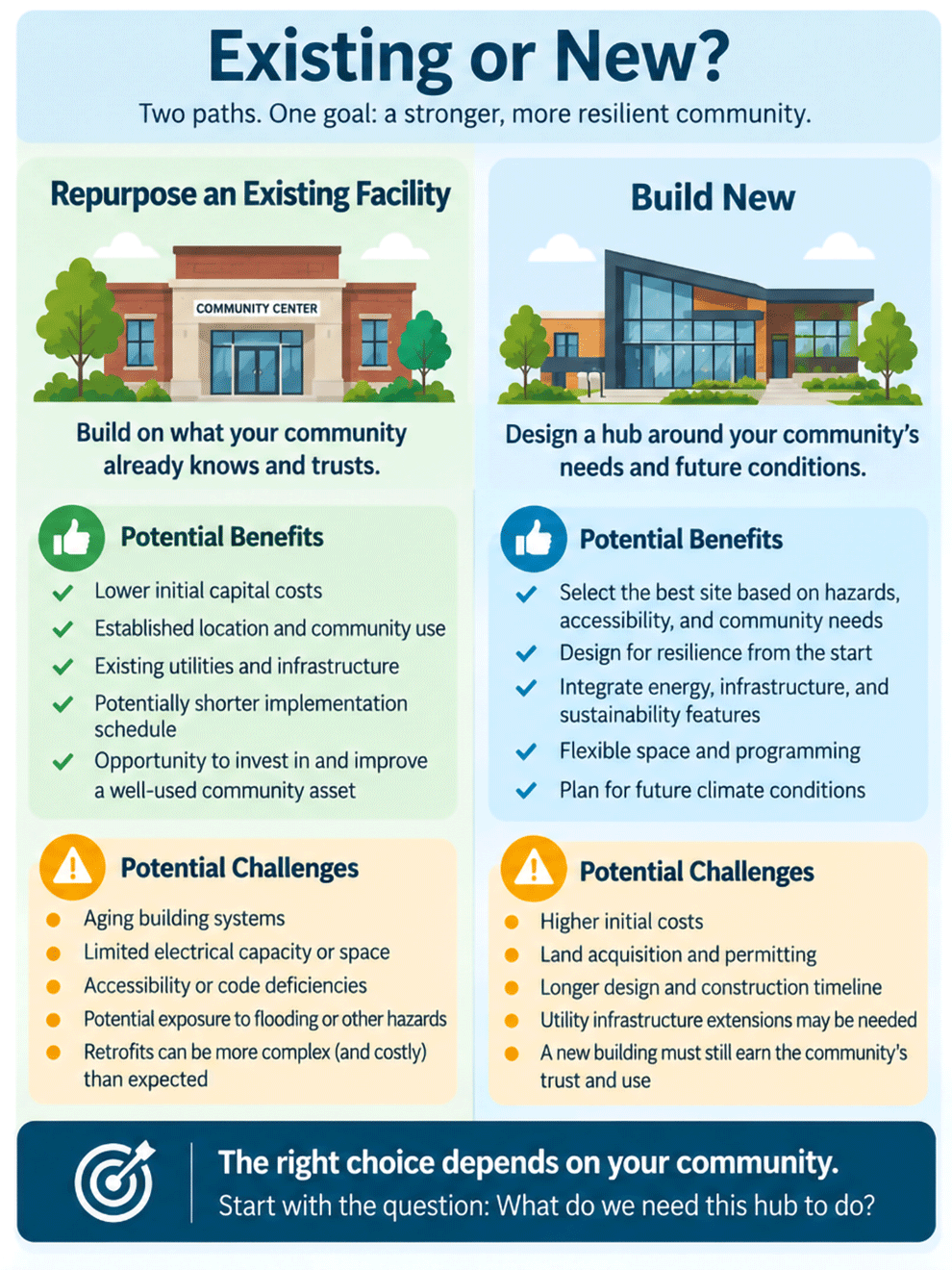
In some communities, adapting an existing building will make the most sense. In others, a purpose-built facility may provide greater long-term value. Neither approach is automatically better.
Repurposing an existing facility
Libraries, community centers, schools, senior centers, recreational facilities, faith-based organizations, and other community-serving buildings may be strong candidates because residents already know how to find and use them.
That existing relationship is significant. USDN’s resilience hub model specifically emphasizes established and trusted community facilities rather than facilities that become relevant only when a disaster occurs.
Reusing a building can also take advantage of existing infrastructure and previous public investment and, depending on the facility’s condition, may allow a community to implement a hub incrementally.
But an existing building needs to be evaluated critically.
Its location may be vulnerable to flooding or other hazards. Mechanical and electrical systems may be outdated. Electrical capacity may not accommodate new equipment. The building may have accessibility, structural, space, communications, or energy-performance limitations. And a facility chosen because it happens to be available may not necessarily be accessible to the residents who most need its services. Our work in Quincy, MA to evaluate candidate locations for emergency shelters is an example of some of the considerations also relevant to a resilience hub.
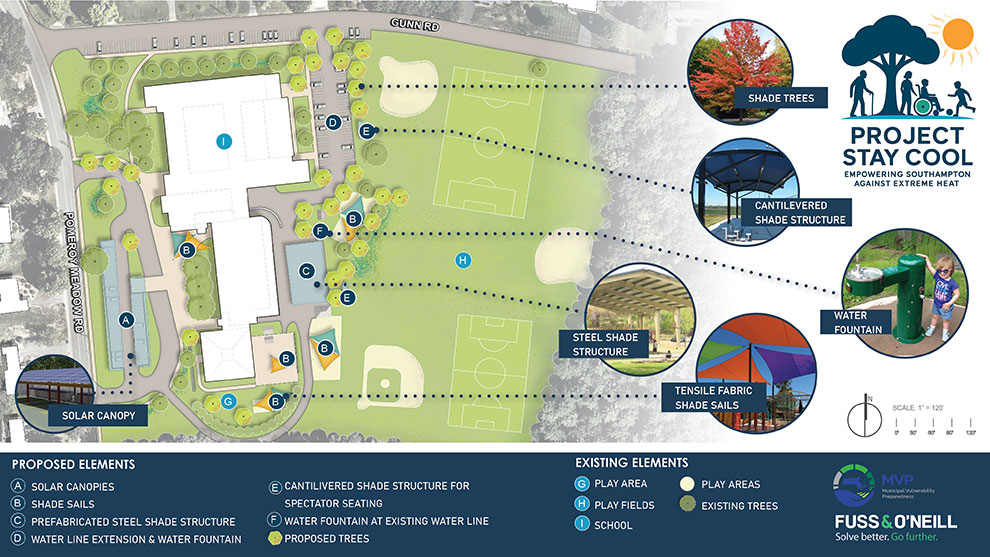
Retrofitting can be an excellent strategy—but only when the facility and location support the hub’s intended mission. Fuss & O’Neill’s building engineering teams, for example, address both new construction and renovation or retrofit projects, including resilient mechanical, electrical, plumbing, and fire protection systems. Our recent work evaluating retrofitting of the HVAC system at a school as part of the Project Stay Cool Southampton (MA) resilience project is one example of such a project.
Building new
New construction creates different opportunities.
A community can evaluate potential locations based on hazard exposure, population vulnerability, transportation, pedestrian access, utility infrastructure, surrounding land uses, and future climate conditions before selecting a site.
The building itself can then be designed around the resilience strategy from the beginning. Critical electrical loads, backup power, renewable energy, battery storage, high-performance building systems, accessibility, flexible programming space, stormwater management, and other resilience measures can be integrated rather than added later.
Location matters because where development occurs can significantly affect a community’s ability to prepare for and recover from natural disasters, reinforcing the importance of integrating resilience into planning and development decisions.
New construction, however, typically introduces additional questions around land acquisition, capital cost, permitting, schedule, infrastructure extensions, and long-term operating expenses.
More importantly, a new building does not automatically become a trusted community institution simply because it has resilient infrastructure.
That is why the first question should not be “What should we build?”
It should be:
“What does our community need this hub to do?”
Once that question is answered, communities can determine whether an existing facility can meet those needs or whether a new facility is justified.
That decision illustrates one of the central challenges of resilience hub development: these are inherently multidisciplinary projects. Treating each discipline as a separate step can create gaps between the community’s original vision and the facility that ultimately gets built.
An integrated project team can instead carry the same resilience objectives through the entire process from initial engagement with the community through visioning, design, and construction:
Listen. Engage residents, municipal departments, community organizations, and other stakeholders to identify everyday needs, emergency needs, barriers to access, and community priorities.
Assess. Evaluate climate and natural hazards, vulnerable populations, candidate facilities, infrastructure, energy requirements, accessibility, and future conditions.
Plan. Define the hub’s functions, operating model, location, critical systems, resilience objectives, and implementation strategy.
Fund. Identify appropriate grant and financing opportunities and develop the planning and technical documentation needed to pursue them.
Design. Coordinate site, civil, structural, mechanical, electrical, energy, environmental, landscape, and resilience considerations as one system.
Build. Carry those objectives through permitting, bidding, construction, field coordination, and project closeout.
Fuss & O’Neill already works across these disciplines. Our resilience and sustainability practice includes climate vulnerability assessment, adaptation design, renewable energy, energy management, flood protection, green infrastructure, and funding and financing strategies. Our planners and landscape architects support community engagement, demographic research, GIS analysis, grant strategy, and grant applications. Our energy capabilities include solar, geothermal, battery energy storage, emergency and standby power, and microgrids. And our construction professionals provide services ranging from bidding and budgeting to construction administration, inspection, contractor coordination, and project closeout.
The value of that integration is continuity: the needs identified at the beginning of the process can remain connected to the decisions made during design and construction.
The strongest resilience hubs are not designed solely around the worst day a community might experience.
They are places that provide value before that day arrives.
They can strengthen community connections, improve access to services, increase energy reliability, support community organizations, and create physical spaces better equipped for changing environmental conditions. During a disruption, those everyday community assets can become critical sources of support.
That is ultimately what makes the resilience hub concept powerful.
Resilience is not only about helping a building withstand a storm. It is about giving communities the resources, relationships, infrastructure, and capacity they need to withstand disruption and recover stronger.
Whether your community is beginning a resilience planning process, evaluating an existing facility, pursuing funding, or preparing to move a project into design, Fuss & O’Neill can help connect the pieces.
Our multidisciplinary teams work with communities from planning and engagement through assessment, funding, design, engineering, and construction to develop resilience solutions grounded in local needs and built for long-term performance.
Let’s explore how an existing community asset—or a new one—could become part of a stronger, more resilient future for your community.
<p>Diane Mas, PhD, REHS/RS is the Chief Resilience & Sustainability Officer at Fuss & O’Neill. Diane supports firmwide efforts to embed resilience and sustainability into planning and design. Combining experience in water resources, impact assessment, and environmental health, she helps clients protect people, places, and infrastructure while advancing long-term value and well-being.</p>
We keep up-to-date on developing technologies, emerging concerns, climate projections, and new regulations. Subscribe to be the first to know how these ever-changing industry topics impact you and how we’re responding.
"*" indicates required fields