Five Questions to Ask Before Your Next Capital Improvement Project


For municipalities, capital planning is rarely about deciding whether infrastructure needs investment. The harder question is where to start. Roadways are aging. Water and sewer systems need upgrades. Drainage problems persist. Public facilities require modernization. At the same time, communities are balancing limited budgets, changing funding opportunities, regulatory requirements, reduced staff and growing expectations from residents.
As next year’s capital plans take shape, it can be helpful to look beyond individual projects and ask a broader question:
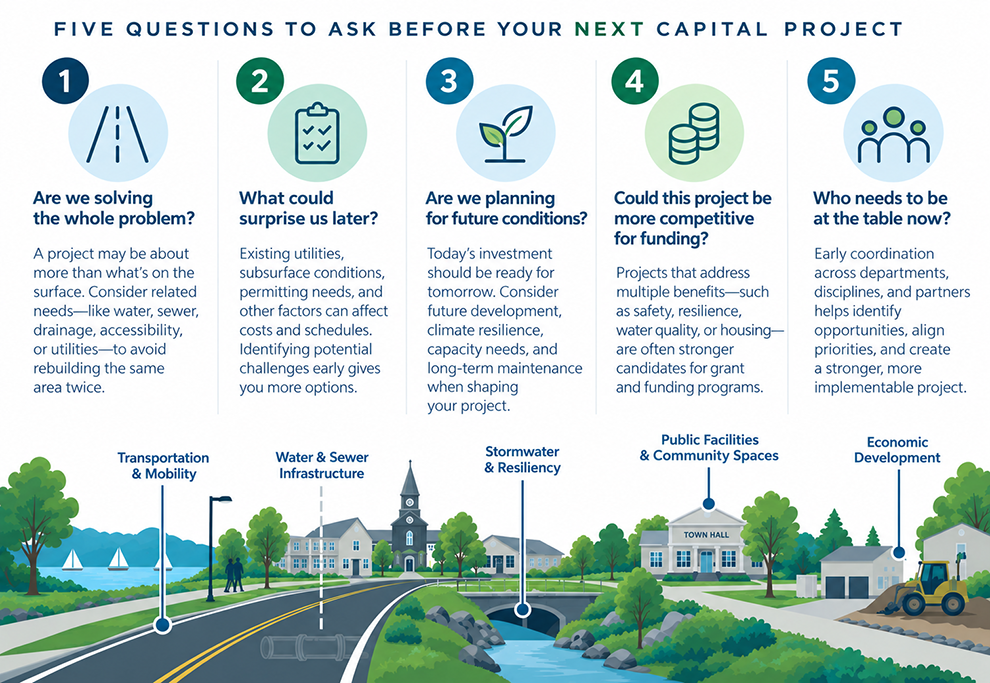
Taking that broader view early can help municipalities avoid rework, reduce risk, coordinate investments, and create more long-term value from limited capital dollars.
A comprehensive approach to capital planning starts with considering how the Town’s infrastructure needs fit together. A roadway may need reconstruction, but the pavement is often only one part of the story. Are there aging water or sewer lines beneath it? Does the corridor have drainage or flooding issues? Are sidewalks accessible? Are pedestrian or bicycle improvements needed? Are utilities planning work in the same area?
Looking at these needs together can reveal opportunities that may be missed if each project is planned separately. The goal is not to add unnecessary scope. It is to avoid rebuilding the same area twice and to make sure one investment does not create a future conflict with another.
Some of the most expensive project problems are the ones that are discovered after design is well underway, or worse, after construction begins.
Existing utilities, subsurface conditions, contamination, hazardous materials, groundwater, property constraints, permitting needs, and aging infrastructure can all affect project scope, cost, and schedule. Identifying those issues early gives municipalities more options. It also helps create more realistic budgets and schedules before a project is formally committed to the capital plan.
Capital projects are long-term investments. The conditions they face 20 or 30 years from now may be different from those they face today. That may mean thinking about future development, changing traffic patterns, more intense rainfall, flooding, emergency access, system capacity, or the long-term maintenance needs of an asset.
For example, a drainage improvement should not only solve today’s problem if future rainfall conditions are likely to recreate it. A pump station upgrade should consider future capacity and reliability, not just replace aging equipment. A public facility project may need to account for future expansion or continuity of operations.
The earlier these questions are asked, the easier it is to build flexibility into the project.
A coordinated infrastructure master plan can help towns position projects for funding by showing how they address broader needs and support long-term priorities.
Funding opportunities often favor projects that address more than one need. A transportation project may also improve safety, accessibility, stormwater management, or economic development. A drainage project may also improve resilience and water quality. A sewer project may support housing or redevelopment.
Recognizing these connections early can help municipalities position projects more effectively when grant or funding opportunities arise. It also helps to have the right information ready. Preliminary engineering, cost estimates, defined project benefits, permitting considerations, and community support can all strengthen a funding application.
Rather than waiting for a grant program to shape the project, it can be more effective to develop a strong project first and understand which funding programs align with it.
Many capital projects become more complicated because an important perspective was brought in too late. Public works, engineering, planning, finance, facilities, utilities, emergency services, and other departments may all have information that affects a project. The same is true of outside partners such as utility companies, transportation agencies, schools, or neighboring communities.
Early coordination can identify competing priorities, overlapping projects, potential funding sources, and opportunities to combine work. It can also help leadership understand the full value of an investment, not just the immediate problem it solves.
Capital planning will always require tradeoffs. There will be more needs than available funding, and not every project can address every issue. But the earlier a municipality looks across departments, disciplines, and future needs, the better positioned it is to make informed decisions about where to invest.
At Fuss & O’Neill, we work with municipalities across New England to help connect those pieces. By looking across infrastructure systems and disciplines early in the planning process, we can help communities identify related needs, understand risks, evaluate opportunities, and shape projects that are more coordinated, fundable, and resilient.
Sometimes the most valuable question in capital planning is not simply “What project should we do next?”
It is “If we are already investing here, what else should we be thinking about?”
Frank brings more than 30 years of municipal engineering and public works experience to Fuss & O’Neill. Having served in leadership roles for the Town of Wilton, Town of Trumbull, and City of Stamford, Frank has extensive expertise in municipal infrastructure, capital improvement planning, project delivery, and public sector processes. His experience overseeing municipal budgets, board presentations, design approvals, and construction oversight provides clients with practical insight into successfully planning and implementing capital improvement projects.
We keep up-to-date on developing technologies, emerging concerns, climate projections, and new regulations. Subscribe to be the first to know how these ever-changing industry topics impact you and how we’re responding.
"*" indicates required fields